
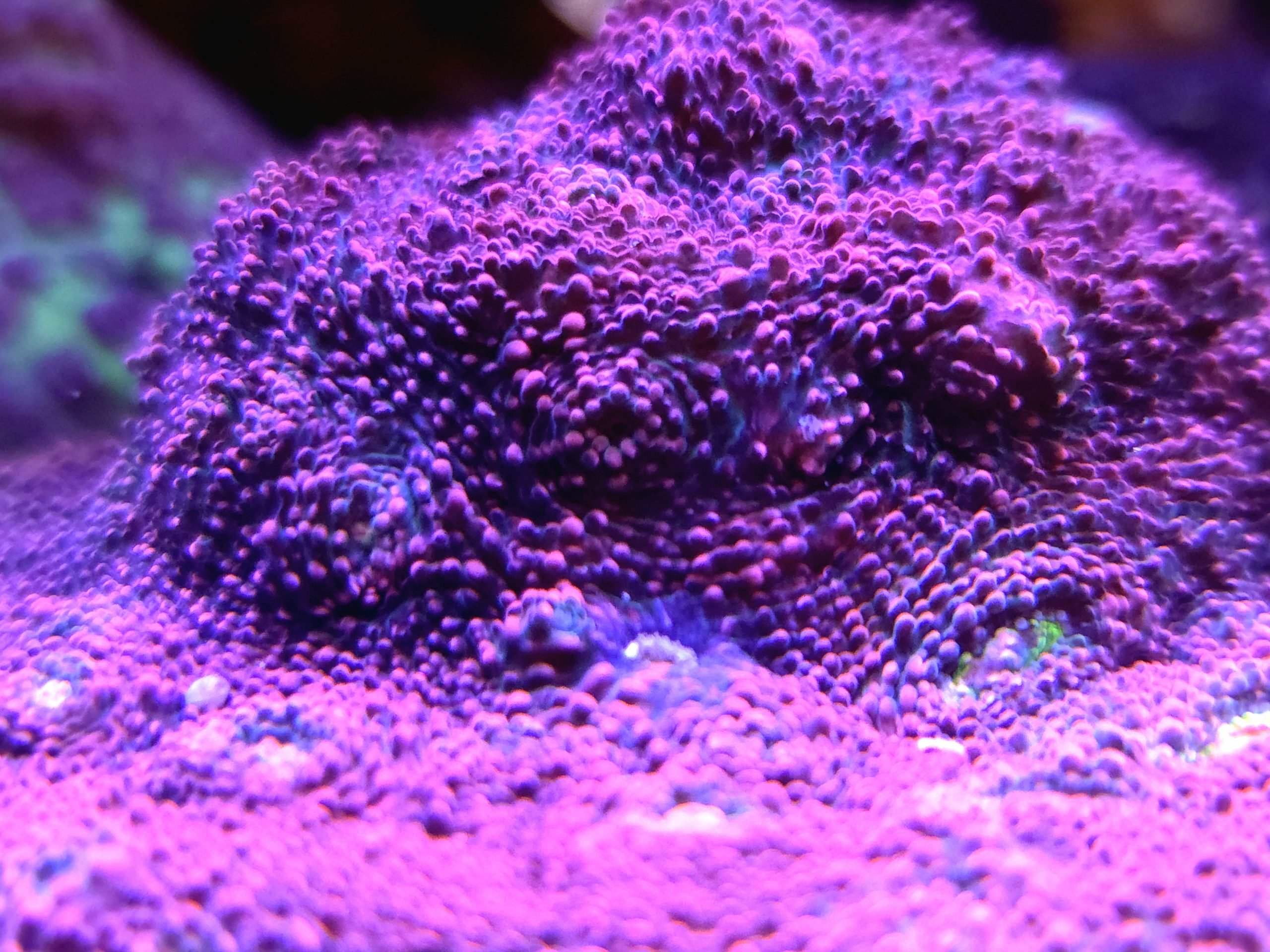
The Pink Boobies Chalice is a standout LPS coral prized for its bright pink eyes, textured surface, and glowing coloration under blue LEDs. While it’s not the hardest chalice to keep, it does best in a stable, well-planned reef system.
Placement, Flow, and Lighting
Dialing in the right spot is the key to keeping this coral happy and colorful.
- Placement: Start it on the sandbed or lower rockwork and move it up only if coloration fades. Chalices can bleach quickly if placed too high too soon.
- Lighting: Moderate PAR (75–150) with strong blue spectrum. If you see tissue receding from the edges, reduce intensity or shift it to a slightly shadier area.
- Flow: Low to moderate, indirect flow. The flesh is delicate—avoid direct blasts from wavemakers that can cause tissue to peel.
Tip: When in doubt, choose lower light and gentler flow. You can always increase both slowly over a couple of weeks.
Feeding and Long-Term Care
The Pink Boobies Chalice responds well to targeted feeding and stable water chemistry.
- Feeding: 1–2 times per week, target feed with small meaty foods (mysis, reef roids, fine pellets) when feeder tentacles are out—usually after lights down or during a blue-only phase.
- Parameters: Keep alkalinity 8–9 dKH, calcium 420–450 ppm, magnesium 1300–1400 ppm, and nitrates 5–15 ppm. Avoid big swings more than chasing “perfect” numbers.
- Space: Chalices can extend sweeper tentacles. Leave 2–3 inches of space from neighboring corals to avoid stings.
- Fragging: If you cut it, use a diamond saw and stable frag rack. Allow several weeks of low-stress conditions for the frags to heal and re-inflate.
With patient acclimation, stable parameters, and gentle flow, the Pink Boobies Chalice can become one of the most eye-catching centerpieces in your LPS collection.
Was this helpful?
Thanks for your feedback!