
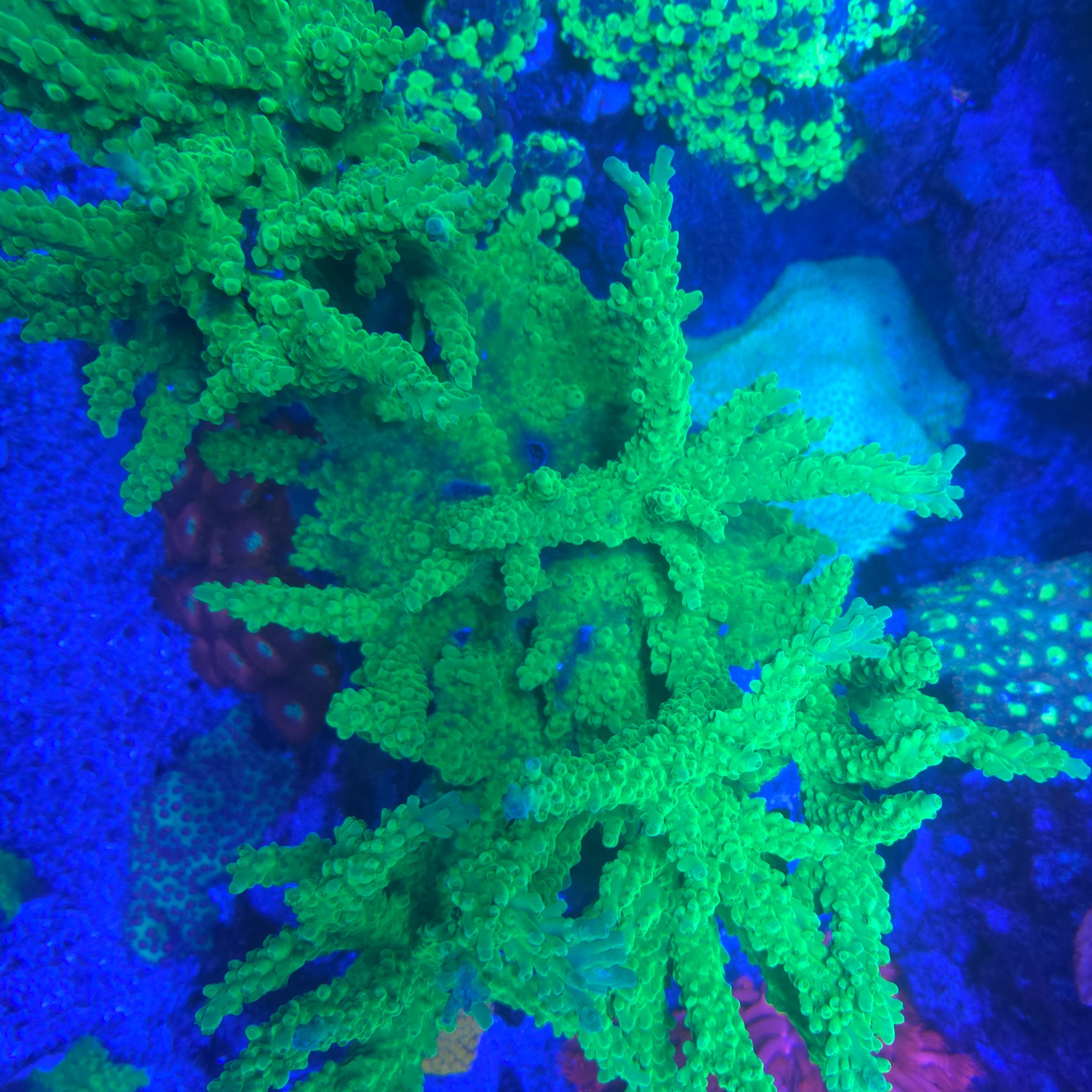
Radioactive Acropora Tortuosa: Care Guide for Vivid Color and Growth
The Radioactive Acropora Tortuosa is a standout SPS coral prized for its neon green and yellow highlights, branching structure, and intense fluorescence under blue lighting. This coral can become a true centerpiece in a mature reef tank when given stable conditions and proper flow.
Lighting and Placement for Radioactive Acropora Tortuosa
This coral thrives under strong, stable lighting and benefits from a careful acclimation period. Sudden changes in PAR can cause paling or tissue loss, so increase intensity slowly.
- Lighting type: High-quality LEDs, T5s, or hybrid systems
- PAR range: Approximately 250–350 PAR for best color and growth
- Placement: Upper to mid-level on stable rockwork with room to branch out
- Acclimation: Start lower or shaded and gradually move to higher light over 2–3 weeks
Tip: Use a PAR meter or borrow one from your local reef club to dial in lighting for your Radioactive Acropora Tortuosa more accurately.
Flow, Water Parameters, and Stability
Like most Acropora, this coral demands strong, turbulent flow and ultra-stable water chemistry. Random, chaotic movement helps keep the branches clean and supports healthy polyp extension.
- Flow: Medium to strong, alternating or pulsing rather than constant laminar flow
- Temperature: 24–26°C (75–78°F)
- Salinity: 1.025–1.026 specific gravity
- Alkalinity: 8–9.5 dKH, avoid swings >0.3 dKH per day
- Calcium: 420–450 ppm
- Magnesium: 1300–1400 ppm
- Nutrients: Nitrate 5–15 ppm, phosphate 0.03–0.08 ppm
Automatic dosing or a calcium reactor is highly recommended once your tank contains several SPS colonies, as demand for alkalinity and calcium will rise quickly.
Feeding, Coloration, and Long-Term Success
The Radioactive Acropora Tortuosa receives most of its energy from photosynthesis, but moderate feeding can enhance growth and coloration. Focus on maintaining clean yet nutrient-balanced water rather than chasing ultra-low nutrient numbers.
- Target feed occasional coral foods or amino acids with pumps turned down low
- Maintain a regular schedule for water changes and testing
- Quarantine new corals to prevent pests such as Acropora-eating flatworms
- Inspect the base and branches regularly for any signs of tissue recession
Under strong blue spectrum lighting, this coral’s glowing tips and contrasting body color truly stand out. Overly white-heavy lighting can wash out its signature look, so consider a balanced spectrum with a strong blue component for display hours.
For more SPS care insights and system planning, explore our guides on SPS coral care and setting up a stable reef tank parameter schedule. If you are building an Acropora-dominated system, our Acropora reef setup guide can help you design a tank tailored to demanding species like the Radioactive Acropora Tortuosa.